
Our Story
The Early Believers
Initially, in 1970s or thereabout, believers used to meet for fellowship at a certain denominational church in the present day Nkubu Town. It comprised people from different administrative regions known as locations at that time. Pioneers of our church used to worship there too. They used to travel all the way from their places of residence in Kirindine Village in Kithunguri sub-location.
The distance between Kithunguri sub-location and Nkubu was a problem to some of them, especially due to the fact that they had to walk all the way. There was hardly any other means of transport for the believers. As a result, believers from Kithunguri used to leave their children behind. This did not mean that children were barred from fellowshipping. Children used to meet at Julius Kwiriga’s land near the location of the present day A.I.C Kirindine Church where they conducted their service. It primarily consisted children and teenagers although some adults used to join them during the service. The adults comprised of their mothers who would be left behind to attend to the children and some other village residents who could not make it to Nkubu.
This went on for a long time until some ideological differences between believers began to creep in. Some members began to withdraw their allegiance from this group of believers and sought other alternatives. Things did not get better nevertheless. Wrangles continued among the believers. The people of Kithunguri were not satisfied. It is at this point that they set out to find another denomination whose programs and services aligned with or at least closely resembled those of their previous denomination.
The Development
During this period, the Africa Inland Church denomination had established a branch in Meru region with a church located in present day Meru Town. Some believers met the A.I.C leaders who explained their programs and services. The believers found these programs satisfactory and appreciated them. This led to the development of the Africa Inland Church branch at Nkubu which gradually strengthened.
More residents from Kithunguri began attending the Sunday service at Nkubu while women and children continued to fellowship at Julius Kwiriga’s land. In the late nineteen seventies and early nineteen eighties, the number of believers from Kithunguri attending A.I.C Nkubu became noticeably significant. This created the need to establish a branch of the Africa Inland Church in Kirindine Village. The process was greatly influenced by the willingness of Julius Kwiriga to donate a parcel of land for the church. Some people also pointed to other reasons for the branching of the church at Nkubu. Some believed that the distance between Nkubu and Kithunguri posed a serious challenge while others cited weak leadership at the common place of worship in Nkubu.
However, the main reason for establishing another branch of the Africa Inland Church in Kithunguri Village was to spread the gospel of the Lord. With various vices affecting the community, there was a need to reach more people and win more souls to Christ. As Jesus instructed, there was a need to preach to drunkards, thieves and all other non believers in the community so that they could be saved and follow his teachings.
At this time, a fully fledged Sunday School program took place at Kwiriga’s land. It consisted of the children of the pioneers of the church and other children from Kirindine Village. The pioneers of the church at Kithunguri were the group that separated from the believers who used to fellowship at Nkubu. Some of the pioneers were Mr Julius Kwiriga who donated the land where the church stands today, Mrs Joanisia Kwiriga his wife, Mr Morris Munyua and his wife Mrs Harriet Morris, Mr Cosmas Thuranira and his wife Mrs Cecilia Thuranira, Felix Nkanata and John Kinyua. Together with other residents of Kirindine Village they collectively formed the A.I.C Muguru Kirindine Church as it was initially called. This name was used because it was believed that the church was located between the villages of Kirindine and Muguru. After land demarcation, it became clear that the church lay entirely within Kirindine. The name was therefore changed to A I C Kirindine.
At first, believers worshipped under a tree on Kwiriga’s land where wooden forms had been set up. They later built a grass thatched structure where services were held. As the number of believers grew, the church found it necessary to construct a larger structure made of iron sheets.
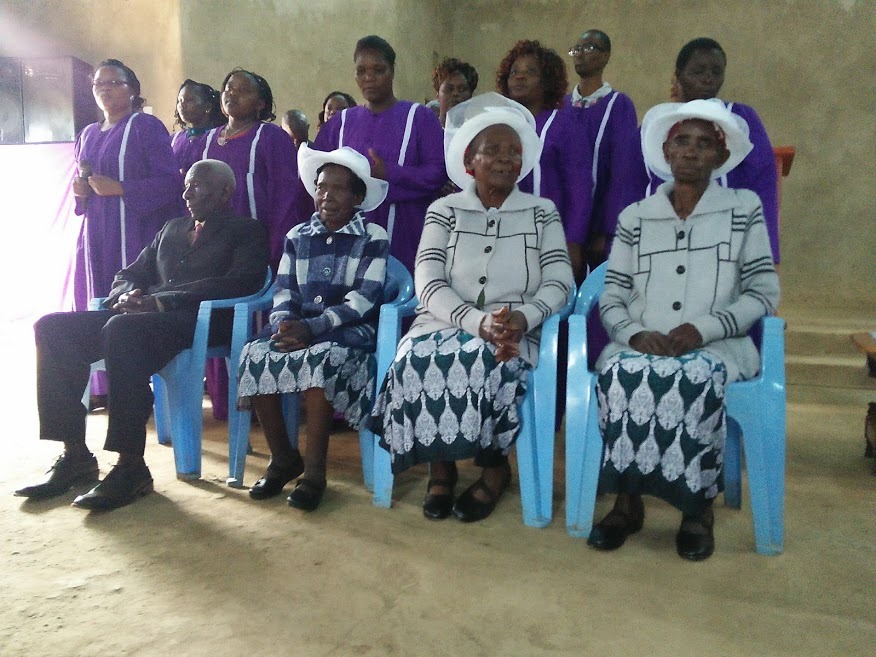
(From left- Mr Felix Nkanata, Mrs Harriet Morris, Mrs Jennifer Kirima, Mrs Cecilia Cosmas)
The Present Day A.I.C Kirindine
A.I.C Kirindine Church was officially commissioned on Sunday, 16th October 1983It was commissioned by Rev Mativo who is believed to have been one of the regional leaders of the Africa Inland Church at the time.
Since then, pastors have been posted to the church by the District Church Council which is one of the administrative councils in the A.I.C structure. Some of the pastors who have served the church include Henry Mutiga who worked with two evangelists David Anampiu and Robert Kirimi, Douglas Nkanga, Jesse Murithi, Rev Jonathan Muthengi, Stanley Muriungi, Patrick Tabuaba, Eliphas Murungi, Grace Muthengi, Benjamin Mwiti and Rev Joseph Muriuki.
The Local Church Council was headed by Morris Munyua who had been recognized by the District Church Council. However, he felt that he could not manage the work on his own and chose other elders to assist him. Some of the elders who held leadership positions then were Harriet Munyua and Jerica Zechariah. Other leaders who held positions at different times include:
Jerica Zechariah –Chairlady (Around 2001)
Silas Mbaabu – Secretary and Sunday School Teacher
Julius Mwebia – Sunday School Teacher
Celina Mbaabu – Chairlady (Around 2010)
Lawrence Gatobu – Sunday School Teacher
Grace Muthengi – Sunday School Teacher
The church grew despite many challenges such as financial constraints, low literacy levels in the community, hostility and internal conflicts. They also faced the difficult task of reaching a community struggling with moral decline. Nevertheless, committed believers remained steadfast.
Over time, the church achieved several development milestones. Believers built a semi permanent wooden structure roofed with iron sheets where they continued to fellowship. Women built a cement water tank which stored water for church use. They laid a water pipe system to supply water to the church. They put up other semi permanent facilities on the church land. They installed electricity and purchased musical instruments and a public address system which have been upgraded over time. Eventually, the church constructed the permanent structure in which believers currently worship.